
Scientific journal
European Journal of Natural History
ISSN 2073-4972
ИФ РИНЦ = 0.204
FORMATION OF THE SYSTEM OF THE REMOTE EDUCATION IN ACADEMIC INNOVATION UNIVERSITY

According to the strategic plan of the Republic of Kazakhstan it was decided by the President Nazarbaev to implement e-Learning system in professional and technical establishments by 2010. Within the government program of development and education of RK it was planned to implement the e-learning system during 2011-2020 years, to reach 85% by the end 2015 and 100% by the end 2020.
Thus one of the most urgent strategic assignments in the developing the system and the method of education is the constant utilization and the usage of the contemporary models along with contemporary information and communicative technologies and the realization of the technologies of innovative education.
Therefore the informational process of education has to function in the following directions:
- Formation of system of constant education as a multifunctional form of development of an individual.
- Creation of various opportunities of the informational education.
- Active implementation of the new methods and materials of the educational program which is to utilize the current informational technologies.
- Formation of the methods and the educational material of the IT and cultural education.
- Formation of a better system of the education with regards of the directions and methods.
According to the definition of UNESCO of the IT education is a collection of various subjects such as the ones of science, technology and engineering which explores the social, cultural and economic problems of nowadays.
Since implementation of IT, the patterns of usage of IT has been shaped in classroom setting:
- The utilization and ‘mechanizations´ the collection of patterns of the educational system.
- Practice of support to a decision making system along with the expert system.
- Ownership and the further usage of the knowledge of IT.
The students are learning to work in a group developing critical thinking and learning to perform scientific research. One of the systematic techniques of contemporary education which correlate to the modern model has proven its effectiveness in e-learning. In the developed countries the e-learning covers all areas of education, being widely used not only in Universities but in schools and establishments of corporative education. The developers of e-learning consider it as a new philosophy of education which envelops all levels of education based purely of IT.
Current IT education gives opportunity to plan and hold the lessons according to the following ways:
- Formation of holistic groups and creation of the supporting materials ( schedule, plan , the content of the lessons and tasks)
- Funneling of the online tests and its development
- Organization of the collective work of the students
- Creating of the work environment both for the students and the teaching staff, i.e. all those who are involved in the educational process using IT.
Availability of the information through IT is possible way of the globalization of education system, making it a current trend of the world. One of the ways to realize that step is creating the ‘open´ knowledge to everyone. E-learning will only benefit from the Informational Technology as the method to be used.
Academic Innovation University (AIU) is the biggest regional, multi-divisional, educational centre and is an exemplary high education establishment that has in its disposal both audio and video technology. Such Universities create a new sphere of education that utilizes the contemporary informational, communicative technology. In order to develop e-learning in Universities to strengthen the both the education methods and the knowledge of students in every part of the world, be it in Kazakhstan, Russia and other countries. For that it is crucial to form the resource centre.
Informational resource centre AIU that has been in both formed and established in Kazakhstan in the light of joining the informational society that will provide an international availability of its resources to all the users.
- Visibility of the resources (rare books, photos as the visual aid, manuscripts, dissertation papers, online libraries, archives, etc).
- Using the IT for modeling the deductive materials on various themes and projects.
- Strengthening both creative education and the research ability.
The research of the IT usage regarding the system of education is based on different models and concepts. Below on the chart there is a pragmatic model of education, being the international and convenient for users. The conceptual significance of this model is in its quality of given knowledge.
Chart 1: Methodological principal of the usage of IT for the Education system of Universities
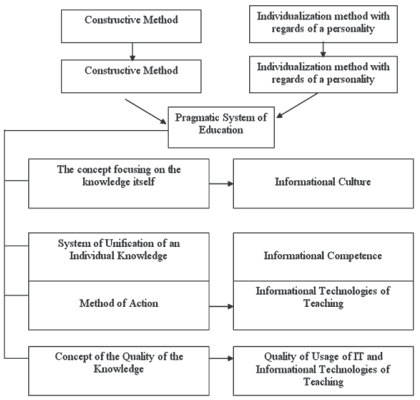
This model of education gives an opportunity to effectively utilize the IT in Universities. Its main parts are IT of education, Informational competence, informational culture and the quality of usage of informational technologies of teaching. All the demands of the population within the education scope would be covered within this model. The teachers/teaching staff performs the role of the supervisor which heightens the mere role of teaching as only providing the information to the students. Provide the opportunity for the users to have the high quality of the digital devices. The main task of AIU is to provide all the residents of the remote regions of the Republic of Kazakhstan.
The education is given not only through the teaching material but also though the monographs and the additional resources. The reference material is completely provided with the encyclopedic establishments. Priorities recipients of AIU are social and humanitarian disciplines, IT and the specialists in the sphere of economy. The education is provided collegially with the high quality specialists and teaching staff. The main components of the project are considered the informational yet innovational resources. The content and the components themselves of the given resources are defined by the teachers.
In consists of all the necessary material needed for the students for the qualified level of knowledge that will go in line with the confirmed and fixed criteria of the educational program.
The material mentioned above is the informational base which are comprise by the teacher/lecturers staff to be used for the remote education. Another vital component of this project is the usage of the internet in order to promote the scientific works of the teachers and professors of AIU to reach the level of the world.
«For the realization of the strategic development of AIU for the marking point of 2015, the centers are created both are of the classical type (libraries/laboratories) and the e-libraries, establishing houses, scientific and educational centers the resources centers. All of them comprise FBBR based on IT which functions as knowledge bases and are conveniently easy to operate.»
In addition to that this system provides the control of knowledge and does not depend on time and conditions of education. Its flow is constant and in absolutely individual.
The remote education opens the following opportunities:
- Allow the visibility the needed information of the seminars, video materials;
- Conduct the trainings;
- Better control of the feedback;
- Widen the audience;
- Accurate statistic data;
- Better assessment of the work of the students;
- Better monitoring of the teaching staff.
This system is actively applied during the process of education. The general work is done by the teaching stuff from the IT center whose main task is to create the teaching material for AIU along with the professors of the University.
The success of the department can be named as servers which give the opportunity for the conducting the lectures and the development of complete courses of remote education. E-education gives a chance to deal with the problems of many educational establishments and minimize the discrepancy of the given material and fixates the knowledge accordingly. With the help of internet it is now possible utilize the help of a remote specialist, additional methods online which will turn out be a cheaper option in general as oppose to the traditional method.
In time of the world wide education, the main factor is the opportunity to supervise the process, students being able to connect with the students world wide.
The system of remote education (SRE) is possible with on-line, letting visibility to both student and the teaching stuff. SRE gives an ample educational privileges working with the individuals despite the limitations. The theory of SRE is vitally important to Kazakhstan, having a vast territory and scattered population whereas the educational centers are only located in the big cities.
Unctional chart of the centralized system for the remote education of AIU is given below.
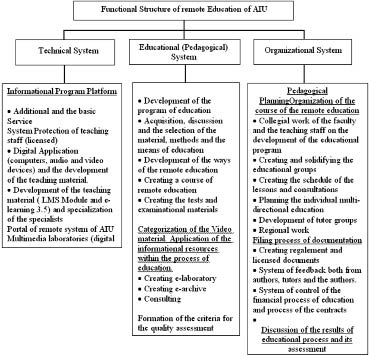
In other words, the remote education is the combinations of methods and the types of education based on the IT and telecommunicate technology which can give way to new ways of innovation and the traditional ones.
References
- Communicative information in the system of education. - 06.08.2001 N10037
- Andreev AA Deductive Base for the Remote Education in higher Educative establishments, diss., doct., PHD - Moscow, 199p-307pp
- Ursul AD The Journey to Knowsphere (The Concept of Surviving and Stabilizing of a Civilization), Moscow 1993.
The work was submitted to electronic scientific conference «Innovative directions in pedagogical education», came to the editorial office
on 01.10.2010.
Библиографическая ссылка
Kystaubayev E.I FORMATION OF THE SYSTEM OF THE REMOTE EDUCATION IN ACADEMIC INNOVATION UNIVERSITY // European Journal of Natural History. 2010. № 6. ;URL: https://world-science.ru/en/article/view?id=21096 (дата обращения: 13.09.2026).